The world, how it works, surroundings, myself, etc.

Saturday, October 08, 2005

Morality and the Constitution

I always used to wonder why the opposition starts demanding the ruling party(-y+ies) to own MORAL responsibility whenever they falter. I mean, why moral responsibility. Why not constitutional responsibility? Why not legal responsibility? Turns out, they can't. The government is not constitutionally/legally responsible for anything. I repeat. The government is not constitutionally/legally responsible for anything. There's not a single law (or even a suggestion) in the 395 odd articles of the Constitutional crap that can hold the government responsible for anything. The opposition, therefore, keeps blackmailing on moral grounds, for, it can't do anything better.

In other words, the government can do whatever it pleases. The Supreme Court, the highest court of appeal in India, will keep expressing discontent, but they can't do anything either. Their hands are tied. They are just supposed to interpret the constitution -- not act as per righteousness. In such a scenario, I feel that the government is actually very very moral whenever it does anything. What else, if not morality, stops it from modifying the constitution to make amendments that ensure that the same party keeps winning every time? What else, if not morality, stops them from framing laws making their rule permanent? Nothing. Pure morality. All strong words like sovereignty, democracy, liberty, et al, combined don't have enough power to stop this -- and yet, we have the government performing at least some degree (+ve or -ve).
G B Shaw mused:
Democracy is a device which ensures we shall be governed no better than we deserve.
What recently happened in my home-state, Bihar, raised similar demands for moral ownership. A "constitutionally elected" assembly was dissolved because the governor did not deem the majority party deserving enough. That was on 23rd May. Four months later, the Supreme Court wakes up (why??) to announce that the governor was wrong. It was constitutionally wrong, but nothing can be undone. Who owns the constitutional responsibility in this case? Oh, I see -- The can-always-be-blamed Mr Nobody. The opposition, unfailingly, has again renewed its demands for the government to own moral responsibility! And the prime minister, it seems, has agreed that he cannot disown moral responsibility. Oh, how cute. I love you. Please go to hell (on your own money).

So hopeless is the nature of the holy constitution of the largest democracy of the world (yeah, it's India) that I wonder -- Isn't this collection of 395 articles no more than a huge and perfect crap-book? What's the use? I tried to reason out some possible uses of the bulky constitution.
  • Use as Toilet paper

Given the bulk of the constitution, each member of the Lok Sabha can get one paper each for toilet-paper usage. Assuming that all the MPs go to the toilet daily (I doubt it, though), it won't last more than a few days, however. Besides, a majority of them won't like using toilet-paper. But those who would, perhaps they can use both the sides of the paper, one side each day.
  • Use for literature study

I confess, I learned a whole set of new words when I first chanced with the constitution. The only knowledge I have of heavy-weight words like sovereign, secular, democratic, republic, fraternity are derived from my school civics book describing the constitution. Besides, the composition is enticingly poetic. I still remember:
"Article 32 confers upon the citizens of India the right to constitutional remedies. ...."
Ah, don't worry what this right is -- 'tis too impractical. This is the only place in my 22 years of life that I have seen the "confers upon" phrase being used, and I find it sweetly poetic. Perhaps the makers of the constitution mistook this exercise as an endeavor towards the Nobel Prize for Literature. They didn't get it -- and they died of shock. "We, the people of India, having solemnly ....." is another favorite and by-heart.
  • Use as a flare

There still are several parts of the country that suffer from freezing cold. The pages of the constitution can burn for quite a while to provide some warmth. I'm told the pages are good, and hence, they should sustain fire for quite some time.
  • Making Kites

This is a perfect usage. Use the pages as kites. Boring holes in the pages will give additional delight and attaching a tail would suit the page's content to a T.

That's it. No more practical uses of the crap called the Constitution of India. Sorry founding fathers. None that I can think of presently. And no -- it does not deserve the Literature Nobel, either!

Al Qaida's Hiring

It's true. Al Qaida's Hiring.

I had heard and read that the economy was going strong, that the bears were unable to hold back the bulls who had been raging the stock market with each passing day. But that the upbeat mood has tingled till Al Qaida too still trickles me. So, they've placed proper advertisements asking people to join their force.
Someone please take up the issue with our placement officer. Schedule a Pre Placement Bombing (akin to PPT) soon. :-)

Wednesday, October 05, 2005

Thy OS is thy religion


Imagine the Year 2015 AD: Barely 10 years from now

The world is casted based solely on one demarcation: your religion,
except that it's not actually Hinduism or Christianity, or Islam but
instead your OS. Your OS is your religion; it represents you, teaches
you, guides you and inspires you. There are great heroes to sing of --
they've done groundbreakingly significant work in the upliftment of your
OS (Linus, Jobs, Gates to name a few). The preamble of the crappy
Constitution of India is rewritten to include the term "equality of all
Operating Systems". To the phrase "equality in protection by law
irrespective of caste, creed, color, sex, sect" is appended "or
operating system".

There'll be some secular political parties, some pseudo-secular, and
some infamously communal (with deep religious attachment towards their
OS-es). There'll be communal wars in the name os OS-es.

And then there'll be some Nazis who won't tolerate any disgrace to their
religion -- either use their OS, or die! Takeovers follow when some
profilic superpowers try to spread their religious colonies throughout
the globe (or every other planets perhaps). Divide-and-rule based on
your OS still works. There is widespread anarchy in the name of one's OS.

Then there'll be a Mahatma. He'll be too lazy to attach himself to any
OS -- if you format his system and install your OS, he'll acquiescedly
offer his other PC as well (his forefathers used to offer the other
cheek when slapped on one). He'll be assassinated by a virus of the same OS.

Children's names rhyme with the OS internals -- Kernel Prasad, chmod R
Shastry, Insmod Pandey, Modprobe Chaurasia, Ipod Vidyadhar, Zotob Gates,
Bill Nimda, etc. Marital and funeral rituals are tied closely to the
nature of booting and crashing of your OS, respectively.

Whoosh! I'm waiting for 2015.

Wednesday, September 28, 2005

Halting the gears


It's general knowledge that glxgears can be used to get a quick peek of a graphics card's performance. glxgears is fill-limited, that is, the frames-per-second (FPS) depends on the size of the window. I describe here a small exercise with glxgears: Halting the gears.

Increasing the window size decreases the FPS. However, the perceived sense of rotation (clockwise or anti-clockwise) of the gears appears to switch as you increase the window size. That is, as you drag the corner of the window and make it larger, the gears will appear to be rotating clockwise and then at a point they'll apear to be moving anti-clockwise and then again they'll appear to moving clockwise at a point... and so on. This is akin to the rotation of a fan wherein you can sometimes feel the blades moving in a direction opposite to the blades' actual direction of motion. So, after making x no of rotations, if a point p on the periphery of a gear lands ahead of it's original place, the perceived sense of rotation is the same as its actual rotation direciton. However, if the point p falls short of its original place, the gear will be perceived as rotation in the opposite direction.

The Exercise: Drag the corner of the window to increase the size and bring it to the point such that the perceived sense of rotation of the gears is just about to change. At this juncture, it'll appear that the gears aren't even moving -- as if they're halted. It's a bit difficult to manouvre the size to a perfect standstill, but it's worth the pains!

Tuesday, September 27, 2005

Techies' In-expressive-ness

Techies are Inexpressive. Techies understand things, they analyze things, they reason out things, but they just aren't able to express it. They feel at a loss of words when contemplating description. For instance, if they are impressed, they have, in their gamut, precisely only the few words: cool, ulti-(mate), fundoo. Other more articulate and suiting adjectives remain foreign to them. Of these, the word "cool" is pretty vehemently abused. They have a bit too many numbers, equations, and logic going in the left lobe of their cerebrum to be able to attend to the artistic calls of the right lobe. Understanding things in terms of equations is OK but when it comes to several social aspects, equations simply falter. To answer in a more technical way, the descriptions of social interactions and understanding can be expressed only in very high degree equations, well beyond the impulses of the left-lobe. And I'm doubtful of even this.

With the breed of Geeks, the situation is even worse. Talk to them for a minute and you'll realize how inarticulate they can be. Ask a computer geek a doubt and he'll answer you back with a string of technical jargon, most of them obscure commands, and this array will be terminated by a broad grin (if you are lucky) emanating out from his bespectacled face. Needless to say, you didn't understand a thing and you are left with a similar doubt, only transformed a different and unfriendly space. Actually, they are not to be blamed too.
 -- PS: Exceptions are everywhere. I'm not referring to those. 

My short tryst with Death


First, a direct lift off from my yesterday night's diary entry:

Glass Cleaner is dying
One of my fishes, the one that used to spend most of its time stuck to the aquarium's glass walls, is dying right now. It had jumped out of the water and onto the floor, a shock for me when I returned back to the room. I put it back in water, but its fins are stuck. I can still see the to and fro movement of its lungs as it breathese, but the fins are still stuck. It cannot move its body. Though it seems to be trying hard for survival, gasping for breath, I don't think it can. By the time I'll be awake tomorrow morning, it'll be dead -- and I can't do anything about it! Oh! no. Even as I'm just writing this, it made a desperate attempt to move and has changed its place to the other corner of the aquarium. But why is it trying to reach the water surface? Please don't jump out again. Please don't die like this before me! I've covered the top of the aquarium now and put in some fod. The other two fishes are having their feed, whereas the subject of this writing is standing almost vertically on its tail, its body still appearing stiff. How painfully it must've writhed on the floor -- why did it jump out? Why does it want to change its silent life to a painful death? Why does it still want to jump out?

The smallest fish, a tiny body with a tiny mouth, is nowhere to be seen. Where did it go? Did it too jump out? I searched everywhere on the floor. I cannot find it. Instead, what I find is some flies and random insects sitting motionless. Oh! no, they too are dead. One is a more than usually large beetle, black and upside down -- its arrangement of legs are silent. Another is a black but grasshopper-like flying insect -- it can't move, its dead. There are innumerable other small flies, worms, ants too! What happened in my room -- did Yamaraj make a visit? And where must've the little fish jumped off?

I now look back at the aquarium, and find a black and white strip of body below some yellow stones. Oh! no, that must it be -- that is it. It's dead. I take it out of the water. Oh! my God, it's abdomen is eaten up -- it's completely hollow -- what happened? I cannot see what's inside and I throw it out.

But what exactly happened in my room? I remember well that everything was fine when I left it some 3 hours ago. Death, it seems, danced its way in my room. If I sleep, will I wake up? Has death left or ....?


Back to this blog:
I was scared like hell yesterday night. Luckily, when I woke up this morning, the glass cleaner fish is alive. It has survived. And so have I.

Monday, September 19, 2005

What's a "hi"?

Hi

I thought Hi was no more than a salutation. But seeing the overuse of this small word, I have reason to believe that it is being abused for varied purposes. You see it everywhere. A signification multitude of my mails have the subject "Hi", primarily used by someone who wanted to send me a mail but wasn't sure of the subject, but still didn't want to leave the subject line unfilled. I just got a mail which dealt with a sysadmin-related problem, but even this was greeted with a "Hi" in the subject line. The rest of the mail was entirely unrelated to the preamble of Hi. Don't people realize -- it's perfectly ok to leave the subject line blank instead of filling it up with the unnecessary Hi.

Looking at various other instances of Hi, every chat session invariably begins with a Hi. Actually, it's nice. Follows the KISS principle. Want to begin a letter, say Hi. Want to start a conversation, say Hi. Wish to start a speech, say Hi. Wish to write an invitation, say Hi. The problem is that it's not used as a salutation but as an opener, as if to get things in motion. We don't begin with a Hi because any other thing wouldn't suffice, but rather just to begin -- akin to clearing one's throat before a conversation. What would happen if everything began with a Hi? God would invent you and say -- Hi (instead of tathastu). The first thing you'd speak to a newborn would be -- Hi. Yamaraj would land at your doorstep and say -- Hi. Imagine every research paper beginning with a -- Hi. The morning newspaper starting with a Hi. The PM addressing the nation on 15th Aug and starting with a Hi. Often people look at you with awe and astonishment if you utter the name of one-who-must-not-be-named. But with the growth of Hi, people around you would be sent shuddering with astonishment if you _did_not_ begin anything with a Hi (one-that-must-be-named). Your examination paper question paper would start with a Hi. The answer-sheet will have a Hi already printed. Even then a student will append a Hi. A lawyer would drop the usual "Your Honor" salutation and begin his legal proceedings with the quintessential Hi. The judge, instead of saying "Objection sustained" would say -- "Hi, Objection sustained". The convict, standing before the jury would start with a Hi.

It gets even more painful. Even advertising isn't spared. Hutch is so confident about the applicability of Hi that they pay for gigantic billboards but use only a tiny corner of it to say -- Hi. Probably if Hutch had it's way, when you receive a phone-call, everything else would be proceeded by a machine-generated automatic Hi for bot the caller and the callee.

PS: Even this post begins with a Hi.

Friday, September 16, 2005

My theory on A$$holes


Here I describe my theory and speculations regarding the breed called A$$holes.

A$$holes: The breed of people who can't think. They perhaps have brains, but they just refuse to think. The idea of logic, brain, and the like is foreign to them. Invariably, they employ the power of speech as a substitute to the power of thought, which they never use.

A$$holicity: A$$holicity, or A$$holic content, of a population is defined as the ratio between the number of A$$holes and the size of the population. It can be expressed as a fraction or as a percentage. For example, if it's known that the A$$holic content of a population is 50% (or 1/2), it means that one out of every two person in that given population is an A$$hole.

A$$hology: The study of A$$holes. It's important because this helps in their identification. The farther you are from them, the better.

Postulates:
  1. A$$holes are everywhere.
  2. The A$$holicity of any given population is at least 1/3.
Theory: As a child I had known the story of a monkey and a bird. It was raining heavily. The bird was sitting happily in its nest, whereas the monkey was shivering in the rain. The bird felt pity and suggested to the monkey: "You are way stronger than I am. Why don't you build a home for yourself? Then you won't have to shiver like this." This monkey was an A$$hole. Needless to say, the logic didn't pierce into his top row. Instead, he attacked back and tore the nest of the bird itself.
That's how A$$holes are. It'll take all the power in nuclear forces before they accept reason.

George Bernard Shaw mused:
Few people think more than two or three times a year. I've made an international reputation for myself by thinking once or twice a week

It's bewildering to see how poorly used thought is.

Ayn Rand said:
If I were to speak your kind of language, I would say that man's only moral commandment is: Thou shalt think. But a 'moral commandment' is a contradiction in terms. The moral is the chosen, not the forced; the understood, not the obeyed. The moral is the rational, and reason accepts no commandments.
God didn't force thoughts upon us. He left humankind with this choice -- and this was the flaw -- how can someone make a choice without thinking?
Everyone is entitled to be stupid. But some people abuse the privilege. -- Anonymous

Returning to the A$$holic characterisics, they are omnipresent -- in the park, in the lawn, in the school, in the bus, everywhere. You can't get rid of them. But maintaining distance is crucial. Their content in any of these population will always be at least 1/3. There's no magic about this number. It's just the theoretical lower limit. The actual (practical) A$$holic content of a population can far exceed this. For instance, the A$$holicity of places like Parliament, Assembly, politically motivated meetings are in the tune of 98%. The rest 2% are passers-by.

Even if there are only 1/3rd A$$holes in the world, they'll collectively account for 2/3rd of the mess. Practical values shoot this messiness to over 80%. This fits the 20-80 rule that 20% of the people are responsible for 80% of the productive work done.

A$$holes are important, nevertheless. In times of depression or when you are feeling low, they serve as the lower reference-point of a depressed state. You'll automatically start feeling better. Whenever you are depressed, think of an A$$hole.

Conclusion: Never reason with an A$$hole.
 

Thursday, September 15, 2005

Ufff.. the day today


What a pathetic day it was today. Things were going wrong with such
monotonic consequence that the even my PC gave up, just a day before I
have to give a demo to someone from Microsoft Research (sponsor for my
Display Wall project). It was wreckage. I was yet to complete the
preparations for tomorrow and here it was, my 1GB inferno lying
exhausted, uninterested in booting up despite all my pleadings. The HCL
guys were called up. I suspected an SMPS failure, as is generally the
religion in such outbreak; but the HCL guy declared that it was
something more serious -- the motherboard. It needed to be replaced. Now
started the wait for another guy from HCL service center who brought a
new motherboard. Things were settled not before 7:00 in the evening. I
had to settle with 512M RAM as this present motherboard supposedly isn't
supporting 1GB (needs some BIOS update, the HCL guy tells me).

And that was just one story. Today was the worst ever network failure in
the history of IIIT that has passed before my eyes. The central switch
in the server room broke down. Even rebooting the central switch, as is
infamously the norm in the server room, didn't work; it was hanging no
sooner it was booted. This ate up the whole day, and my lab (Room 227)
didn't get the network back even after all the others had got back their
life. Things improved only by 7:00.

The last two "No computers day" at the institute didn't leave me this
helpless but today I felt -- the PC doesn't work, the network doesn't
work, what the hell! what am I supposed to do?

Ufff.. the day today.

Sunday, August 28, 2005

Making firefox real fast

Not for nothing is Firefox the coolest browser. A simple tweak and now all the sites open almost instantaneously. I don't have to see the status bar loading the page. Here's what I followed:

Open Firefox 1.0 and in the address bar type: about:config

1. Find browser.tabs.showSingleWindowModePrefs and double click on it so it = true
2. Find network.http.pipelining and double click on it so it = true
3. Find network.http.pipelining.maxrequests double click on it and change it from 4 to 100
4. Find network.http.proxy.pipelining double click on it and change it = true

That's it.

What do these changes do?
1. Then enables advanced tab options in your Tools/Options page
2. This enables option #3.
3. This makes FF use 8 threads to each page.. Bascially, if you thought FF was fast before, try it after this.
4. Use this if you are behind a proxy.
I'm sure tonnes of such tweaks can be done, especially with the myriad number of extensions available.
---
Courtesy: http://www.i-hacked.com/content/view/59/42/

Wednesday, August 24, 2005

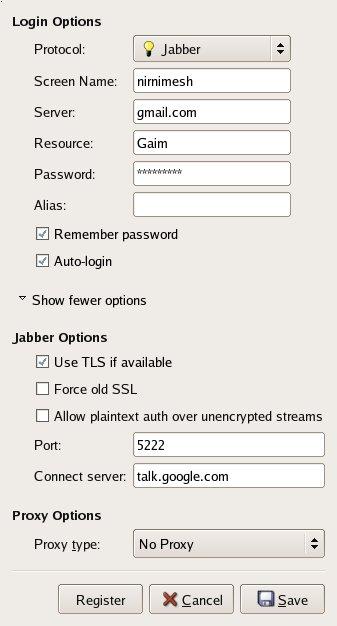
Using Google talk with GAIM

Kudos to Google for making sure that its newly launched talk service could be used with Gaim.
Google talk uses the standards compliant Jabber protocol. They will be the FIRST IM service to use the IETF messaging and presence standard. Thank you again, Google!

My Gaim settings are like: (they work at least here in IIIT)


Tuesday, August 23, 2005

My AC hates me

The AC hanging over my head in the lab hates me.

I had complained about it at least once in one of my blogs about how people keep oscillating it between high & low temperatures instead of just setting it to the desired temperature. And now methinks I have to face the consequences. The AC spills water. Not every time, though; only when you want to have water being showered on your head the least (Murphy's right, you see). It doesn't spare my PC's monitor too. As a workaround I've put a paper on the monitor to protect it but what about poor me? Should I sit in the lab with an umbrella? Even though it has been cleaned two times, yesterday itself being once, it hasn't stopped it's outpourings. I know there's a Rain God, Indra, whom people plead to in case of drought or drain. But is there a God for rain from ACs? I'm yet to hear about it. Who should I offer my prayers and offerings to?

I hope the AC doesn't get angrier. In case it does, it might start dropping other things as well, and then I might not be left to complain any more.

Monday, August 22, 2005

The ctrl-alt-delete test


Abstract: There are so many clues that mute devices can give about their owners. One such effective method is described here as an example.

Motivation: Given a PC, you have to make out whether the owner runs Windows or Linux on it. The system is switched off. No, you are not allowed to switch it on. In case, it's a dual boot system, find out if the user uses Windows more or Linux.

Background: Any regular computer user would know that the keys on the keyboard erode with use. With time, dust settles on the keys but they are consumed by the fingers which touch them. However, this consumption of dust away from the keyboard is not even. The keys which are used the most, look the shiniest. Therefore, the shininess of the keys give an idea of the relative frequency of keys-usage.

The ctrl-alt-delete test: Any windows user knows the importance of the Ctrl-Alt-Delete dose. It's needs to be injected every now and then, often out of wilderness. I argue that if the computer runs Windows, the Ctrl-Alt-Delete keys will be the shiniest. Windows users spend most of their time with the Ctrl-Alt-Delete keys. One might refute the claim, saying that the Space key could be shinier and it's used most often. No. Windows users hardly touch the keyboard except for this Ctrl-Alt-Delete medication. Interestingly, windows users instead use the mouse to bring up the start menu even though there's a full-fledged key on the keyboard dedicated just to this purpose (the windows key / super key).

Conclusion: The keys on the keyboard provide several clues about the user. Some of these are quite unexpected. Had Conan Doyle been alive, Sherlock Holmes would have found many uses of these in his investigations for the truth.

Future Work: Space bar, the longest key on the keyboard, can reveal a lot. For instance, if the space bar is eroded from the right, this means that the user is right handed. The relative shininess of the other keys also tend to let the cat out of the bag. The F & J keys can reveal if the user has to look at the keyboard while typing or is a touch-typist (can type without looking). The W, A, S, D keys reveal if the user is a gamer. So much so that the ASL (age-sex-location) keys will tell you if the user is an avid chatter! Many more of these promising arenas remain unexplored.

Thursday, August 18, 2005

Microsoft promoting viruses?

As if the already existing windows wasn't vulnerable enough,, Microsoft keeps announcing about the vulnerabilities that it discovers in Windows and releases a patch to be applied for it's protection. If you don't follow verbatim the instructions issued from Godfather M$, hell breaks loose over you. This happened with the recent Zotob virus too. Here's how: In barely 3 days after the announcement of this vulnerability on Windows, proof of concept code demonstrating the exploit was available on the internet, and in two days hence the worms were in their hunting spree. However protective the intentions of Godfather M$ be, for people who did not heed to its warnings in a mere 5 days, they rendered their systems useless.

Or is it a strategy from M$ to stop illegal usage of Windows? The patches are available to legal users only. If it is so, then M$ is trying to cash in at the cost of some legal users too, who happened to be 5 days late in analyzing the situation!

Wednesday, August 17, 2005

Why TeX?

10 Good Reasons for using TeX

These are the reasons most often cited for using TeX, grouped into four areas: Output Quality, Superior Engineering, Freedom, and Popularity.

  • Output Quality You write documents to be read and understood. Your first concern should be: how good is the output? Is it as readable and as useful as possible? Is it, even, beautiful?
    • 1) TeX has the best output. What you end with, the symbols on the page, is as useable, and beautiful, as a non-professional can produce.

      This is especially noticable for complex documents, such as ones with mathematics; see this sample (from Rogers's Recursive Functions). It also holds for documents that are complex in other ways: with many tables, or many cross references or hyper-links, or just with many pages.

      Even on simple documents TeX does a better job than a word processor. Compare these samples of plain text (from Herigel's Zen in the Art of Archery) done in Word and TeX. These are short and the typographic differences are subtle but even a non-expert may see that the TeX page looks "more right." The word processor's page has some lines with wide gaps between words and some lines with too many words stuffed in (contrast the second paragraph's second line with its third). TeX's output is more readable.

    • 2) TeX knows typesetting. As the plain text samples in the prior item illustrate, TeX's more even line spacings are a consequence of its more sophisticated algorithms for making paragraphs and for hyphenating.

      Another way that this expertise gives better output comes in setting technical material. TeX moves the task, as much as possible, into the software. For instance, it automatically classifies each mathematical symbol as a variable, or a relation, etc., and sets them with appropriate amounts of surrounding space. It also sizes superscripts, and many other things. The result is that, because your document follows the conventions of professional typesetting, your readers will know exactly what you mean. You almost never have to fret with the formulas. They just come out right.

    The quality of output is the best reason to use TeX.

  • Superior Engineering Everyone has been frustrated with software that is slow, fat, buggy, or that undergoes frequent incompatible version changes. TeX will not give you those troubles; from a Computer Science standpoint, TeX is very impressive.
    • 3) TeX is fast. TeX ran quickly when it was developed in 1978 and so on today's machines it is very fast. It is easy on your computer's memory and disk space, too.
    • 4) TeX is stable. It is in wide use, with a long history. It has been tested by millions of users on demanding input. It will never eat your document. Never.

      But there is more here than just that the program is reliable. TeX's designer has frozen the central engine, the actual tex program. Documents that run today will still run in ten years, or fifty. So "stable" means more than that it actually works; it means that it will continue to work, forever.

    • 5) TeX is stable, but not rigid. A system locked into 1978's technology would today have gaps. That's why TeX is extendable, so that innovations can be added on, layered over the underlying engine.

      An example is the LaTeX macro package, which is the most popular way to use TeX today. It is a front end to the engine, affecting the way authors input their work. It adds conveniences such as automatic cross references, indexing, a table of contents, automatic numbering of chapters, sections, theorems, etc., in a variety of styles, and a straightforward but powerful way to make tables.

      LaTeX also adds a philosophy of encouraging authors to structure their document by meaning rather than by appearance. For instance, a LaTeX author might produce emphasized text by typing "it is \emph{hot} here" instead of specifying italics. This approach has two advantages. First, since it is a computer language command, it makes the type style, size, and spacing uniform throughout your document. Second, once the information is in the computer then you can do more with it. You can, for instance, distinguish between text that is italic because it is emphasized, and text that is italic because it is the name of a ship, perhaps by adding a command \ship{..} that saves the names of all ships for a separate index.

      And, LaTeX itself is extendable. There are thousands of "style files," which do everything from adapting the basics to the needs of the American Math Society, to making cross-references into hyper-references, all the way to allowing you to add epigraphs, the short quotations that sometimes decorate the start or end of a chapter.

      Just because LaTeX is the most popular macro package doesn't mean that it is the best one for you. Many others are available; see the the TeX Users Group's interest page.

      So TeX has been, and is being, developed and extended in many ways. (See also the nex two items.)

    • 6) The input is plain text. TeX's source files are portable to any computing platform. They are also easy to produce automatically, for example as output from a program. They are compact; all of the files for my 450 page textbook and 125 page answer supplement fit easily on one floppy. And, they integrate with other tools such as search utilities.

      Use of this type of input file stems from an overall mindset. TeX arose in the world of science and engineering where there is a tradition of cooperating closely with fellow workers. A binary input format, especially a proprietary one, is bad for cooperation: probably you have had to go through the trouble of upgrading a word processor version because coworkers upgraded and you could no longer read their files. With TeX systems that rarely happens -- the last time that a LaTeX release lost some backward compatibility was in 1995.

      There are even ways to run TeX directly from XML input, which many people think is the standard input format of the future. So, with the TeX formatting engine in the middle, the input front end may be adjusted to meet your needs, and changing times.

    • 7) The output can be anything. As with inputting, TeX's outputting step is separate from its typesetting. The TeX engine's results can be converted to a printer language such as PostScript, or to a web language such as PDF or HTML, or, probably, to whatever will appear in the future. And, the typesetting -- line breaks, etc. -- will be the same no matter where your output appears. (Did you know that word processing output depends on the printer's fonts, so if you email your work to someone with a different printer then the line and page breaks may come out differently?)

    Many people find that TeX's input language fits with how they think about their material. For instance, a scientist might describe a formula to a colleague over a telephone using TeX constructs.

  • Freedom Most computer users have heard about Free and Open-Sourced software and know that, as with the GNU programs, Linux, Apache, Perl, etc., this style of development can yield software that is first class. TeX, along with associated materials such as index makers or style files, falls into this category.
    • 8) TeX is free. The source of the main tex engine is open (the Free Software Foundation uses it for their documents). All of the other main components are open, also.
    • 9) TeX runs anywhere. Whatever meets your platform -- Windows, Macintosh, a variety of Unix, or almost anything else -- you can get TeX, either freely distributed or in a commercial version.

    So although the core of TeX was written some time ago, it fits well with today's trends.

  • Popularity Using the same system as many other people has advantages. You can get answers to your questions. Your problems might well have already been solved. And, because of this large user base, your system is sure to be around for years.
    • 10) TeX is the standard. Most scientists, especially academic scientists, know TeX. Research preprints, drafts of textbooks, and conference proceedings, all are regularly produced with TeX. As a result, many publishers of technical material are set up to work with it.

      Because it is the standard, TeX's support by other technical software is the best. For example, there are editing modes to make input convenient, such as AUCTeX for Emacs. Another example is that most computer algebra systems, such as Maple and Mathematica, will give output in TeX. And no doubt technical software developed in the future will support TeX, also.

      In addition, TeX is used by many people outside of the sciences, for all of the reasons given in this document. For instance, there is a way to produce beautiful critical edition texts.

    You wouldn't want to use a bad system simply because it is popular. TeX has earned its user base for sound reasons, some of them given above. Nonetheless, the existence of such a base is itself one reason to adopt a software package.

---
From: http://ctan.org/what_is_tex.html
Related: http://ctan.org/documents/whyTeX/whyTeX.pdf

Thanks to Parry for leading me to http://ctan.org/

Monday, August 08, 2005

What after bleeding?

To bring out the technical edge of a product, I used to hear it being termed as burning edge. But that was long long back. Then came the term cutting edge which referred to really out of the world capabilities for use by professionals. And now I hear bleeding edge. Such products (esp graphics cards) have fundoo amateurs and single-headed fanatics too as their audience. I wonder what edge the future would be on. What after bleeding edge? Rubbing edge? Wiping edge? or.. is it clotting edge?

Sunday, August 07, 2005

The perils of Over-Expression

Over-Expression is a routinely occurring phenomenon in world order these days. Things are often over-stated. Communication, it turns out, takes place mostly in the superlative sense. For instance, if the mess food is bad, one might label it as intolerable even though it would have been quite agreeable a meal. Most advertisements promote their products as the best of its kind. Mediocrity is infamous. Average expression is unheard of, though average quality is not uncommon. As if the superlative band has expanded to gobble up the average band.

There are a number of factors which lead to such a world order:
  • Strong feelings
This is the case in which things are over-stated without intention or deliberation. One might have a deep attachment with something which one sees getting damaged and therefore reacts voluptuously. One doesn't see the larger picture here. For instance, the recent MMS imbroglio in which a college student was caught selling (potentially) obscene stuff was a clear depiction of emotional outburst. Several people saw it as a misuse of technology. Some other stringent-minded people, however, viewed it as an attack on the women race -- as if this was the last straw and they had no choice but to demonstrate vehemently their outburst. World order becomes an exception for a while. Clearly, the entire scandal was over-advertised. Other significantly severe abuses of women's rights go unheard of while this one attains herculean proportions. Such narrow-minded syndrome needs a broader and beyond-the-sight therapy. There is more than meets the eye (or even emotions/hearts).
  • Partially deaf reaction mechanism
Owing largely to insensitiveness to routine behavior, normal expression goes unheard. Unless a situation is expressed in leviathan proportions, it doesn't beat anything on the ear-drums of the people involved in the reaction mechanism. For instance, a stoic complaint made to the telephone department for a non-functional line would have large chances of going amiss. Same for a complaint for preparing a faulty electrical line. However, when the situation assumes titanic proportions (dharnas, bandhs, etc), the reaction mechanism springs to action in a whisker. Call it nature but the bottom line is that humans are surprisingly adaptable and react only when over-expressed (damage mode). Computers, however, don't work in this damage-control mode. They continue with the routine mode equally well even after millions and millions of repetitions. Perhaps, therefore, it'd do good to replace reaction mechanisms with automated (lifeless) controls.

A very commonly occurring example of all this is with the operation of the AC in my lab. Instead of keeping the temperature to an agreeable value, it's often kept intolerably low. This is when it's hot and the AC is just started. As expected, the room starts freezing in a while and then someone would just pop up and switch it off (instead of increasing the temperature to the agreeable value). And the room heats up again. Greedy desire of instantaneous results leads to this cycle being continued, even though in a long run it is far from optimal.

Saturday, August 06, 2005

To remain or not to remain.. contemplations


For some time now I've been sitting over a decision which I need to make -- Should I quit my sysadminship? No, it's not about money. SysAdminship was never about money anyway. So what is it? And am I prepared for it? These are the questions I must answer.

True that I was filled with joy when Nayani asked me (circa March, 2004) whether I wished to become the sysadmin. My joy knew no bounds then. I was always fascinated to see the smart black servers through the server room's glass doors. I was just a DigLib maintainer then and I did have a few reasons of entering into the server room, albeit only occasionally. And then it happened. I was appointed as the sysadmin (along with smr). Likewise I bequeathed the technical air around myself, which is the characteristic of anyone on this responsibility, I presume. I had long undergone the changeover from Windows to Linux. A certain degree of pride naturally infused into me as I was permitted to open and enter into the server room whenever the need be. All the servers lay there before me, which I best describe as: waiting for being commanded by my fingers. Not surprisingly, my image too underwent a changeover. My nickname changed from Ajeeb to root. A signboard bearing "System Administrator" was hung on my door.

All this was as if my complete self was getting submerged into the being of a sysadmin. As if I was getting lost behind this tag. But the job was interesting, the power addictive, , the road challenging, and I continued to tread on it. To avoid myself getting pampered and lured into misdemeanor, I had vowed to myself never to encroach upon the privacy of any person -- I needed strong determination against this temptation and I have been successful satisfactorily. A number of major changes took place in the server room management and network infrastructure and my number of hours in #111 (Server Room) had gone up, and I kinda loved it. Being on this hot seat also chanelled a lot of queries from people to me, all of them technical, and it's always fun answering them.

But all this has been there for over an year now. Things have changed. Times have changed. I have changed. Power doesn't allure in the same way now; don't know if the lack of it would hurt, though. I've learnt a lot of things in this responsible position. But the cynosure of my contemplation is -- Shouldn't I move on? I mean, being a sysadmin was good, but that's not nearly the destination. There's a long long road waiting to be traversed. In some ways, I've just now embarked upon the journey. The sysadminship load constantly mitigates my independence. Of late, there have been a number of instances when I've been irresolutely frustrated and dissatisfied with the latency of the server room activities (most of them beyond my hands), but the net result tends to reflect my efficacy too. My numerology indicates that I'm a bit stubborn; I have trouble leaving a thing once acquired. But with seasoned thoughts I know I can achieve a changeover. Does quitting sysadminship give me this changeover?

Submerged with such notions I had asked PJN sir for an advice. I was equally inclined towards both sides and all I needed was a backing from him to push me further in that direction. According to him, however, the decision is all mine. There are so many strategic developments that I'd like to see undertaken in the server room; so innumerable ways in which the process should be improved. But should I continue to get myself involved? I must lessen my load, I agree, but should I quit altogether? Should I listen to my gut feeling and quit now to avoid tumbling down the rabbit-hole? I'm looking for answers. The decision is still under contemplation.

Friday, August 05, 2005

My_new_roll_no % 3 != 0.. still

It's hardly been 3 days after I posted about my joy when I realized that my new roll no was divisible by 3. But now, it's not. Today it was announced that my new roll no is: 200102005 instead. Now, this isn't divisible by 3. The numbers less than 200102005 which divide it are: 5, 43, 215, 930707, 4653535 and 40020401. But the good thing is that of these factors, 3 are prime and 3 are composite. Having 3 prime factors is not bad! And.... if you add 5 to my roll no, it becomes divisible by 3 again. :-) (5 because my dual degree is a 5 year programme and that *should* have a part to play in the calculations.)

Thursday, August 04, 2005

Darwinism, the guiding principle for opensource and blogging

Little did Charles Darwin know about the idea of open source or blogging when he explained about "The Origin of the Species", but the same idea of "survival of the fittest" prevails here as well. That open source is analogous to letting a person choose what profession he wants to be in is the crux. This is because he'll perform the best in the profession he really wants to be, otherwise perish, giving way to better ones.

Accepting open source as a business model might seem foreign to most. "Why do something for free," one might argue. Well, you don't have to. No one forces you to blog. No one forces you to write and distribute open source. The crucial factor here is "force". You can do something best *only* if you truly love it. FULLSTOP. RedHat, supporting the Fedora project, is a gallant example of making money in symbiosis with OpenSource. And we've not even talked of the Google yet. Isn't it a working business model?

The threat of non-reliance on open source is a non-threat actually. Same for blogging. No one would read a blog which is poorly written or wrong. But something which many people do read *has* to be good. As humans, we communicate. One could ask, "Why speak for free?" I'd rather say, it's human to speak. It's just natural. Hearing is optional. And if there are many who hear me, it implies that I'm a good orator. So my speech will thrive only if I'm fit enough to speak -- survival of the fittest, or auto-perish of the frail. Parallely, to blog is natural. To try one's luck in working open source is natural.

Paul Graham has an excellent article on What business can learn from Open Source. Amateurs giving professionals a run for their money is natural. So what does that mean? -- there can be no professionalism? No. A person doesn't have to do one thing only. If I'm an employee, that doesn't mean that I don't talk, does it? But perhaps I'll be able to perform excellent in my amateur self -- or better still if my profession self and the amateur self are the same.